
Darkhorse Golf Club — Master Planned Development, Infrastructure, and Parcel History
Organized narrative summary with collapsible sections for County staff, counsel, and reviewers.
Overview
Darkhorse Golf Club is a master-planned golf and residential development located in Nevada County, California. The project was approved through a series of recorded subdivision maps, development agreements, and improvement plans that contemplated a fully integrated golf course, practice facilities, irrigation infrastructure, and supporting parcels functioning as a single, unified project.
Since its original approvals in the late 1990s and early 2000s, Darkhorse has experienced a complex history involving under-capitalized development, lender foreclosures, bond calls, and fragmented ownership. These events have resulted in unfinished infrastructure, severed parcels, and unresolved land-use and access issues that persist today.
This landing page assembles and organizes the underlying documents, exhibits, and visual evidence to present a clear, chronological, and fact-based record of how the project was approved, how it was partially constructed, and how certain critical infrastructure parcels became separated from the operating golf course.
Original Approvals and Intended Development
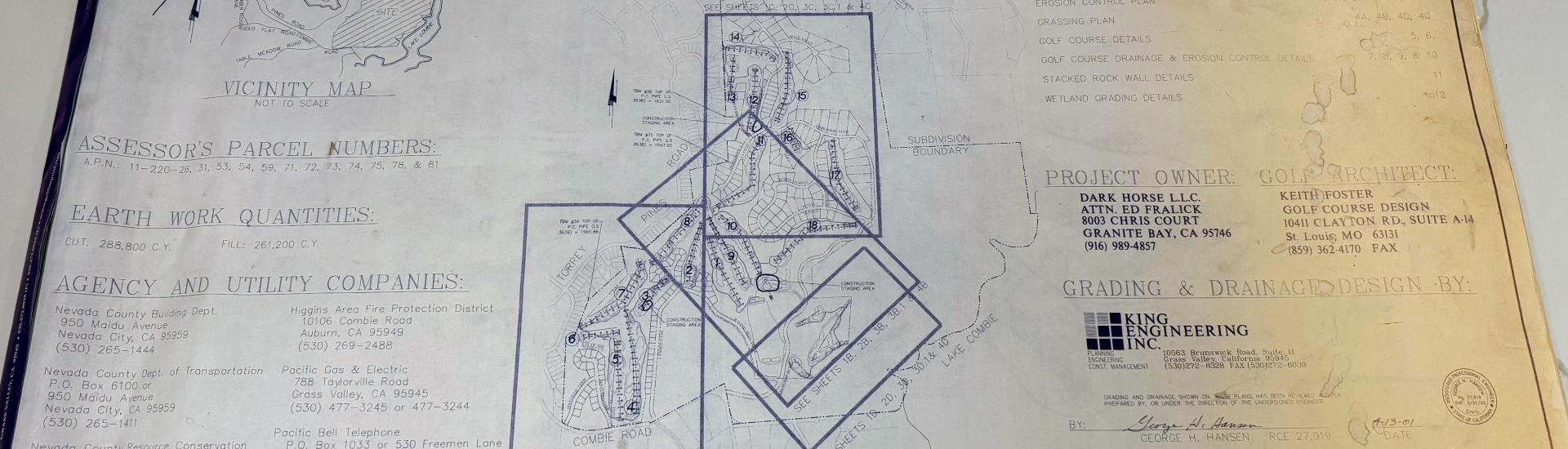
The Darkhorse project was originally approved as a coordinated master plan, not as isolated or independent parcels. The approved plans included:
- An 18-hole championship golf course
- A multi-hole practice facility (including short holes and range areas)
- Centralized irrigation and water-storage infrastructure
- Graded fairways, greens, tee complexes, and drainage systems
- Recorded access, utility, and operational easements serving the entire project
Engineering drawings, subdivision maps, zoning exhibits, and development agreements consistently depict these components as interdependent parts of a single recreational and open-space use, governed by REC and related zoning classifications.
Financial Collapse and Lender Control (2006–2009)
During construction, the original developer relied heavily on high-interest, short-term financing, primarily through Owens Financial Group. This financing structure proved unsuitable for a large, infrastructure-intensive project.
By approximately 2006–2007:
- Construction stalled mid-build
- Roads, drainage, utilities, and golf improvements were left incomplete
- Nevada County was forced to call subdivision improvement bonds to stabilize essential infrastructure
Following the developer’s default, Owens Financial foreclosed on substantial portions of the project, including numerous residential lots and non-lot parcels. Control of the project shifted from a development entity to a lender-driven asset disposition process, fundamentally altering how the approved master plan was treated.
Fragmentation and Parcel Severance
As foreclosure and subsequent transfers occurred, certain parcels that had been planned and constructed as functional components of the golf course and irrigation system were separated from the operating course.
These parcels include areas that show evidence of:
- Grading consistent with golf fairways and practice holes
- Installed irrigation mains, laterals, and electrical conduit
- Engineered drainage corridors and unfinished shaping
- Designation on approved plans for tees, greens, and water facilities
Despite this physical and documentary evidence, these parcels were conveyed separately from the golf course, creating practical, legal, and operational conflicts not contemplated in the original approvals.
Evidence of Partial Construction
Photographic exhibits, engineering drawings, and field observations demonstrate that portions of the severed land were actively under construction as part of the golf course prior to abandonment:
- Trenched and buried irrigation lines extending hundreds to thousands of feet
- Electrical conduit serving planned course features
- Rough grading of fairway corridors and tee complexes
- Drainage features that now collect water due to incomplete finish work
These conditions reflect interrupted construction, not undeveloped raw land.
Current Ownership and Ongoing Impacts
Darkhorse Golf Club is currently owned and operated as an active golf facility. However, the separation of key infrastructure parcels has created:
- Constraints on completing originally approved golf features
- Unresolved access and utility issues
- Maintenance and drainage challenges
- Land-use conflicts inconsistent with recorded approvals
The current owner has assembled historical records, recorded maps, planning exhibits, and physical evidence to demonstrate that the project was never intended to function with these parcels isolated from the golf course.
Purpose of This Document Collection
- Provide a centralized, transparent record of the project’s planning and construction history
- Allow reviewers to independently verify facts using original source documents
- Distinguish between approved intent, partial construction, and later parcel severance
- Support informed review by County staff, counsel, and decision-makers
No single exhibit tells the full story. When viewed together, the documents demonstrate a continuous narrative of planned unity, interrupted execution, and subsequent fragmentation.
Conclusion
The Darkhorse Golf Club project was approved, engineered, and partially built as a unified recreational development. The later separation of key parcels occurred after project collapse and foreclosure, not through any re-entitlement or redesign process.
This record is provided to assist Nevada County and other stakeholders in understanding the full factual and historical context of the site as it exists today—and as it was originally approved to function.
Document Index — Provided for Review
This page provides organized access to planning, engineering, legal, title, and exhibit materials related to the Darkhorse property. Links are provided for convenience and open the corresponding Google Drive folders in a new tab.
A. Planning & Zoning
Zoning maps, planning exhibits, land-use context, and County planning reference materials.
B. Engineering & Infrastructure
Engineering plans, irrigation, drainage, grading, conduit, and infrastructure documentation.
C. Legal & Recorded Property Documents
Recorded agreements, final maps, development documents, and governing legal records.
D. Title Parcel & Ownership History
Parcel history, ownership chains, assessor records, and title-related documentation.
E. Exhibits (Nevada County)
Curated exhibit materials prepared for County review, enforcement actions, or court filings.
F. Current Improvements on Severed Parcel
(Building,Pumps,Irrigation Lines,Main Lines, PG&E Transformer, Electrical Conduit + More)